Canonical
on 13 July 2022
July 13th, 2022: Canonical and Google Cloud today announce an optimised Ubuntu image for the preview of Tau T2A virtual machines (VMs) on Compute Engine. Google Cloud users will benefit from running Ubuntu, a popular cloud operating system, on a secure, scalable, and highly cost-effective cloud infrastructure. The Ampere® Altra® Arm-based T2A VMs are ideal for computing workloads including microservices, application servers, machine learning (ML), open source databases, and in-memory caches.
Canonical has had a long-term strategy for Arm architecture for a decade. At Computex 2012, MiTAC demonstrated their first Arm Server, running Ubuntu. Ubuntu 14.04 LTS was also the pioneer in supporting Armv7-A Cortex-A15 chip and Armv8 SoCs. Since the start of our Arm journey, Canonical has been focused on solving challenges such as: mixed x86 and Arm environments; multiple SoCs; provisioning large deployments; and mixed public and private cloud deployments. Continuing this strategy, Canonical and Ampere have collaborated to bring SOC certified Ubuntu images to the market at launch. Today, the availability of optimised Ubuntu for T2A VMs enables developers to better address these challenges.
“With the launch of T2A VMs on Google Cloud and corresponding Ubuntu images supported by Canonical team, we build on our joint investments with Canonical to optimize customers’ experience on Arm architecture.” said Jamie Kinney, Senior Product Manager of Google Compute Engine, “Together, we offer customers the ability to use their familiar packages and libraries in the most popular operating system, including the latest Ubuntu 22.04 LTS, and the upcoming Ubuntu 22.10.”
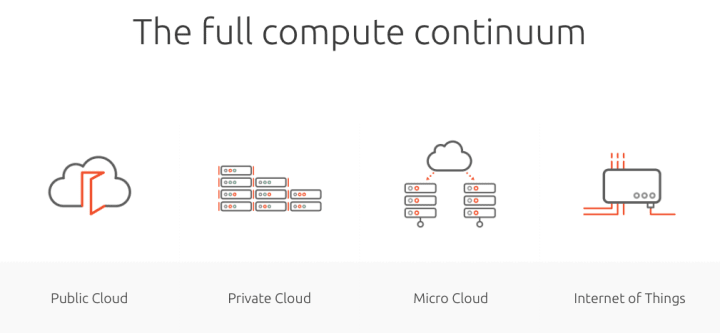
Canonical has products that work across the entire compute continuum, which include four domains: Public Cloud, Private Cloud, Micro Cloud, and Internet of Things. We are committed to supporting Arm in all four domains. As we know, each of these domains has its own key ingredients, constraints, and opportunities; we focus on enabling efficient operations in each domain. In the Public Cloud domain, Ubuntu is one of the world’s most popular operating system across all public cloud.
Optimised Ubuntu images are available in each of the hyperscale cloud providers, including Google Cloud T2A machines. In Private Cloud, we have an entire Arm-friendly technology stack aiming to remove operational friction from all layers of the data centre, from bare metal to applications. MAAS provides the bare metal provisioning; MicroK8s orchestrates containers; and Juju allows for lifecycle operation automation in the application and the infrastructure layer.
In Micro Cloud, where resources are constrained but high capacity is expected, we enable a cloud-like architecture. So, distributed Arm nodes are empowered for faster iteration and localised low-latency compute. In the IoT domain, Snap containerises application dependencies and Ubuntu Core updates itself and its applications automatically. Secure, robust, easy to install, easy to maintain, and easy to upgrade are the key qualities we bring to Arm IoT systems.
“Ampere and Canonical have closely collaborated to support customers at launch across their entire product line. Our collaboration extends from silicon to application allowing customers to develop and implement their workloads with the same support and functionality they have come to expect” said Sean Varley, Senior Director of Solutions at Ampere Computing. “We’re excited to offer new Arm native use cases such as cloud gaming and Android application emulation running Canonicals’ Anbox Cloud on T2A instances.”
Enjoying the benefits of Ubuntu and the performance of T2A machines, enterprise customers will be able to run mission critical workloads in a cost-optimised manner. Moreover, the Arm-based platform is also particularly suited for new use cases, such as Anbox Cloud.
Anbox Cloud, Canonical’s solution to run Android at high scale on any cloud, benefits from the performance and density that the T2A VMs can provide. Anbox Cloud enables use cases such as cloud gaming, automation of Android applications and regular testing.
“Running Android on native Arm is key for Anbox Cloud to deliver high performance, density, and application compatibility. Google Cloud announcing these powerful T2A virtual machines is another cornerstone to further unlock Arm availability in the cloud for our customers.” says Simon Fels, Engineering Manager for Anbox Cloud at Canonical.
Getting started
Getting started with Ubuntu on a Tau T2A VM is simple. You can choose the Tau T2A machine type and Ubuntu as your operating system when you create a VM in Google Compute Engine.